Dilexi te: On Love for the Poor by Pope Leo XIV
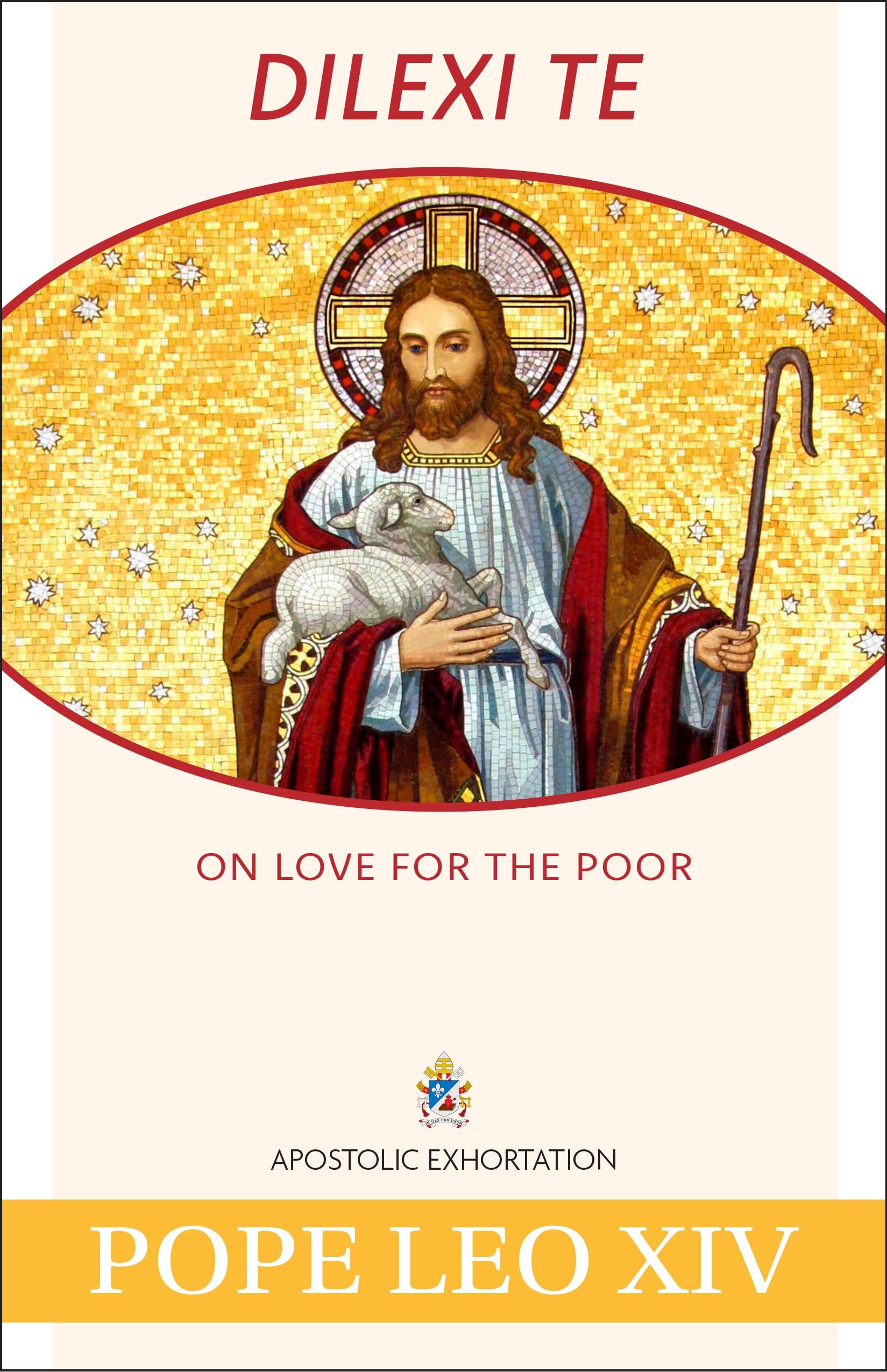
(Rome: Vatican, 2025), 80
Love for the Lord, then, is one with love for the poor...In the poor, he continues to speak to us. (5)
The poor cannot be neglected if we are to remain within the great current of the Church’s life that has its source in the Gospel and bears fruit in every time and place. (15)
The Almighty will not be outdone in generosity to those who serve the people most in need: the greater the love for the poor, the greater the reward from God. (45)
For Christians, the poor are not a sociological category, but the very “flesh” of Christ. (110)
- Dilexi te: “I have loved you” (Rv-03) (1)
- Pope Francis was preparing in the last months of his life an Apostolic Exhortation on the Church’s care for the poor. I am happy to make this document my own — adding some reflections — and to issue it at the beginning of my own pontificate, since I share the desire of my beloved predecessor that all Christians come to appreciate the close connection between Christ’s love and his summons to care for the poor. I too consider it essential to insist on this path to holiness... (3)
CHAPTER ONE: A FEW ESSENTIAL WORDS
- No sign of affection, even the smallest, will ever be forgotten, especially if it is shown to those who are suffering, lonely or in need. (4)
- Love for the Lord, then, is one with love for the poor...In the poor, he continues to speak to us. (5)
- I am convinced that the preferential choice for the poor is a source of extraordinary renewal both for the Church and for society, if we can only set ourselves free of our self-centeredness and open our ears to their cry. (7)
- A concrete commitment to the poor must also be accompanied by a change in mentality that can have an impact at the cultural level. In fact, the illusion of happiness derived from a comfortable life pushes many people towards a vision of life centered on the accumulation of wealth and social success at all costs, even at the expense of others and by taking advantage of unjust social ideals and political-economic systems that favor the strongest. (11)
- The poor cannot be neglected if we are to remain within the great current of the Church’s life that has its source in the Gospel and bears fruit in every time and place. (15)
CHAPTER TWO: God CHOOSES THE POOR
- Preferential option on the part of God for the poor: “ God has a special place in his heart for those who are discriminated against and oppressed, and he asks us, his Church, to make a decisive and radical choice in favor of the weakest” (16)
Jesus, the poor Messiah
- God’s preferential love for the poor comes to fulfillment in Jesus (18)
- Poverty marked every aspect of Jesus’ life...He presented himself to the world not only as a poor Messiah, but also as the Messiah of and for the poor. (19)
- "I often wonder, even though the teaching of Sacred Scripture is so clear about the poor, why many people continue to think that they can safely disregard the poor." (23)
Mercy towards the poor in the Bible
- “Those who do not love a brother or sister whom they have seen, cannot love God whom they have not seen” (1 Jn 4:20)
- Love for our neighbor is tangible proof of the authenticity of our love for God, as the Apostle John attests: “No one has ever seen God; if we love one another, God lives in us, and his love is perfected in us… God is love, and those who abide in love abide in God, and God abides in them” (1 Jn 4:12,16). The two loves are distinct yet inseparable. (26)
- “How does God’s love abide in anyone who has the world’s goods and sees a brother or sister in need and yet refuses help?” (1 Jn 3:17) (30)
CHAPTER THREE: A CHURCH FOR THE POOR
The true riches of the Church
- Pope Sixtus II: He pointed to the poor saying, ‘These are the treasures of the Church’ (38)
The Fathers of the Church and the Poor
- The Church is a mother of the poor, a place of welcome and justice. (39)
- Saint Justin on liturgy: it is not possible to separate the worship of God from concern for the poor (40)
Saint John Chrysostom
- "Do you wish to honor the body of Christ? Do not allow it to be despised in its members, that is, in the poor, who have no clothes to cover themselves. Do not honor Christ’s body here in church with silk fabrics, while outside you neglect it when it suffers from cold and nakedness… [The body of Christ on the altar] does not need cloaks, but pure souls; while the one outside needs much care. Let us therefore learn to think of and honor Christ as he wishes. For the most pleasing honor we can give to the one we want to venerate is that of doing what he himself desires, not what we devise… So you too, give him the honor he has commanded, and let the poor benefit from your riches. God does not need golden vessels, but golden souls." (41)
- "What advantage does Christ gain if the sacrificial table is laden with golden vessels, while he himself dies of hunger in the person of the poor? Feed the hungry first, and only afterward adorn the altar with what remains." (41)
- Charity is not optional but a requirement of true worship. (42)
Saint Augustine
- Ambrose on almsgiving as justice: "What you give to the poor is not your property, but theirs. Why have you appropriated what was given for common use?" (43)
- Augustine: true ecclesial communion is expressed also in the communion of goods...For Augustine, the poor are not just people to be helped, but the sacramental presence of the Lord. (44)
- Leo: "The Almighty will not be outdone in generosity to those who serve the people most in need: the greater the love for the poor, the greater the reward from God." (45)
- Summary of the fathers: "patristic theology was practical, aiming at a Church that was poor and for the poor, recalling that the Gospel is proclaimed correctly only when it impels us to touch the flesh of the least among us, and warning that doctrinal rigor without mercy is empty talk." (48)
Care of the sick
- The Christian tradition of visiting the sick... is an ecclesial action through which the members of the Church touch the suffering flesh of Christ. (49)
Care of the poor in monastic life
- Basil: "to be close to God, one must be close to the poor" (54)
- The cloister is not only a refuge from the world, but a school where one learns to serve it better (58)
Freeing prisoners
- Trinitarians and Mercedarians (60)
Witnesses of evangelical poverty
- Mendicants
The Church and the education of the poor
- For the Christian faith, the education of the poor is not a favor but a duty. Children have a right to knowledge as a fundamental requirement for the recognition of human dignity. (72)
Accompanying migrants
- I was a stranger and you welcomed me (Mt 25:35).
At the side of the least among us
- The poorest of the poor — those who lack not only material goods but also a voice and the recognition of their dignity — have a special place in God’s heart. (76)
CHAPTER FOUR: A HISTORY THAT CONTINUES
The century of the Church’s Social Doctrine
- The poor are possessed of unique insights indispensable to the Church and to humanity as a whole. (82)
- The Church’s Magisterium in the past 150 years is a veritable treasury of significant teachings concerning the poor. (83)
- Paul VI: "the poor are representatives of Christ" (85)
- Gaudium et spes "forcefully reaffirms the universal destination of earthly goods and the social function of property that derives from it" (86)
Two themes of Pope Francis that Pope Leo wants to address include: Structures of sin that create poverty and extreme inequality and The poor as subjects.
Structures of sin that create poverty and extreme inequality
- Structures of injustice are a "social sin" (90)
- "We must continue to denounce the dictatorship of an economy that kills" and condemns the idea of relying upon "invisible market forces to resolve everything" (92)
- "We need to be increasingly committed to resolving the structural causes of poverty...inequality is the root of social ills." (94)
- We ought not to consume in a way that all others can't: We cannot "legitimize the present model of distribution, where a minority believes that it has the right to consume in a way which can never be universalized, since the planet could not even contain the waste products of such consumption." (101, cf. Laudato Si 50)
- "All the members of the People of God have a duty to make their voices heard, albeit in different ways, in order to point out and denounce such structural issues, even at the cost of appearing foolish or naïve. Unjust structures need to be recognized and eradicated by the force of good, by changing mindsets but also, with the help of science and technology, by developing effective policies for societal change." (97)
- "Spiritual conversion, the intensity of the love of God and neighbor, zeal for justice and peace, the Gospel meaning of the poor and of poverty, are required of everyone, and especially of pastors and those in positions of responsibility. The concern for the purity of the faith demands giving the answer of effective witness in the service of one’s neighbor, the poor and the oppressed in particular, in an integral theological fashion." (98, cf. Instruction on Certain Aspects of the “Theology of Liberation”)
The poor as subjects
- We must be attentive to the poor (101)
- We "have much to gain from the source of wisdom that is the experience of the poor" (102)
CHAPTER FIVE: A CONSTANT CHALLENGE
- Caring for the poor has always been central to the Church: "love for the poor is the evangelical hallmark of a Church faithful to the heart of God." (103)
- "No Christian can regard the poor simply as a societal problem; they are part of our family." (105)
The Good Samaritan, once again
- Who do we resemble in the story of the Good Samaritan? (105)
An inescapable challenge for the Church today
- Gregory the Great: "Do not waste the opportunity of doing works of mercy; do not store unused the good things you possess." (108)
- "For Christians, the poor are not a sociological category, but the very “flesh” of Christ." (110)
Almsgiving today
- "I would like to close by saying something about almsgiving, which nowadays is not looked upon favorably even among believers. Not only is it rarely practiced, but it is even at times disparaged. Let me state once again that the most important way to help the disadvantaged is to assist them in finding a good job, so that they can lead a more dignified life by developing their abilities and contributing their fair share...On the other hand, where this is not possible, we cannot risk abandoning others to the fate of lacking the necessities for a dignified life. Consequently, almsgiving remains, for the time being, a necessary means of contact, encounter and empathy with those less fortunate." (115)
- "Almsgiving at least offers us a chance to halt before the poor, to look into their eyes, to touch them and to share something of ourselves with them." (116)
- Saint John Chrysostom is known for saying: "Almsgiving is the wing of prayer. If you do not provide your prayer with wings, it will hardly fly." (118)
- "Our love and our deepest convictions need to be continually cultivated, and we do so through our concrete actions...For this very reason, we Christians must not abandon almsgiving...It is always better at least to do something rather than nothing. Whatever form it may take, almsgiving will touch and soften our hardened hearts." (119)
Topic: Encyclical, Almsgiving
Created: 2023-09-12-Tue
Updated: 2026-06-30-Tue